Archway Tensile is the premier manufacturer, fabricator, and contractor of tensile structures in Gurgaon, delivering turnkey architectural marvels from concept engineering to precision installation. Modern architecture demands a synergy between lightweight efficiency, structural durability, and geometric elegance. As a pioneering Tensile Structure Company in Gurgaon, Archway Tensile bridges the gap between complex structural engineering and striking visual design. Tensile architecture relies on pre stressed flexible membranes supported by structural steel frameworks to create long span, clear view enclosures. By utilizing advanced form-finding software like Easy, coupled with finite element analysis (FEA), we ensure every Tensile Fabric Structure in Gurgaon engineered by our facility withstands severe tropical wind loads, seismic forces, and intense UV degradation while optimizing material usage.
1. Architectural Form Classification & Geometric Typing - The structural integrity of a Tensile Membrane Structure in Gurgaon is fundamentally derived from its geometric form rather than mass. Anticlastic surfaces where the two principal curvatures curve in opposite directions are critical to preventing aerodynamic flutter and distributing loads evenly across the fabric plane.
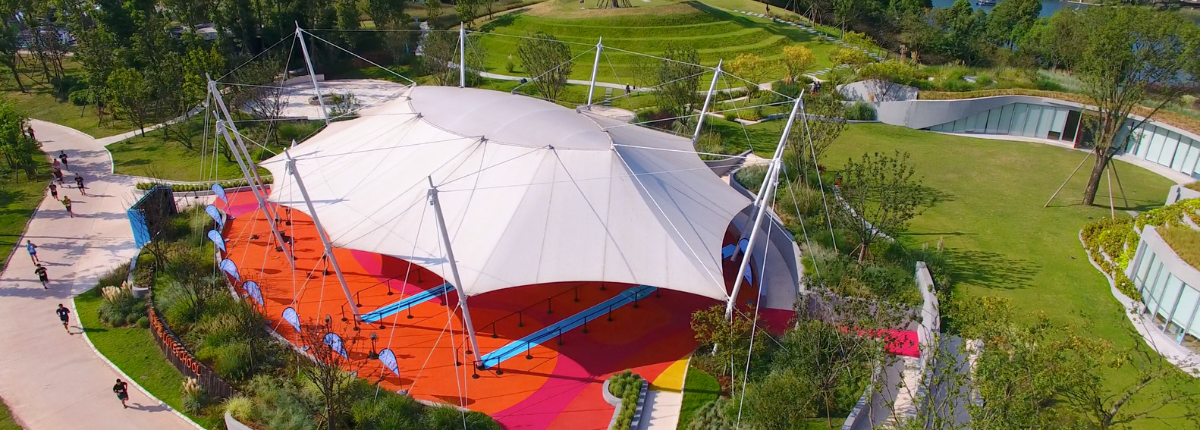
Conical Tensile Structure in Gurgaon: Conical profiles are defined by an outer boundary anchored at a lower elevation and a central apex ring supported by an internal or external mast system. The geometry forces the fabric into a high stress state, providing excellent water drainage and shedding properties under monsoon conditions. At Archway Tensile, our conical designs utilize radial cable networks to eliminate structural wrinkling near the apex, making them an ideal choice for grand entryways and focal landmarks.
Hypar Tensile Structure in Gurgaon: The Hyperbolic Paraboloid, or Hypar, is a classic anticlastic shape created by a four-point boundary where two opposing high points provide lift and two opposing low points provide down-force anchorage. This alternating tension creates a self-stabilizing surface that handles wind uplift with minimal deflection. We engineer custom Hypars using perimeter catenary cables or rigid steel border pipes, depending on site boundaries and aesthetic intents.
Barrel Vault Tensile Structure in Gurgaon: Unlike anticlastic forms, a Barrel Vault Tensile Structure in Gurgaon uses a synclastic approach where the fabric follows a continuous curve supported by parallel structural steel arches. To ensure stability against crosswinds, the membrane is tensioned longitudinally between the arches using edge-pockets or cedar extrusion tracks. This shape maximizes interior clear height clearance, making it highly suitable for long, linear applications.
2. Typology by Commercial & Public Infrastructure Application
Every structural application demands specific engineering considerations regarding span, lighting transmission, acoustics, and foundation loading.
Tensile Car Parking Structure in Gurgaon: Vehicle protection requires structures that maximize clear spans while minimizing foundation obstructions. Our cantilevers eliminate front support pillars, allowing seamless vehicle manoeuvrability. These layouts are designed to mitigate thermal absorption inside parked vehicles by blocking up to 95% of solar radiation.
EV Charging Station Tensile Canopies & Fuel Station Tensile Roof in Gurgaon: With the rapid expansion of clean energy networks, EV Charging Station Tensile Canopies and Petrol Pump Tensile Structure in Gurgaon require fire retardant, high-clearance protection. We utilize Class A fire rated membranes that resist chemical stains and petroleum vapours, ensuring a safe, clean, and modern environment for fuelling infrastructure.
Walkway Tensile Structure & Pedestrian Tensile Walkways in Gurgaon: Connecting infrastructure requires continuous, linear weather protection. Our designs encompass Corridor Tensile Roofing in Gurgaon, Campus Pathways Tensile Structure in Gurgaon, and Metro Station Walkways Tensile Structure in Gurgaon. These systems utilize continuous extruded aluminium tracks to ensure water-tight integration along the entire path length.
Sports Infrastructure Roofing: Enclosing sports complexes requires massive clear spans to avoid column interference with gameplay. Archway Tensile engineers highly specific layouts including:
Tennis Court Tensile Structure roofing in Gurgaon
Padel Court Tensile Roof in Gurgaon
Badminton Roof Tensile Structure in Gurgaon
Pickleball Court Tensile Roof in Gurgaon
Basketball Courts Tensile Structure in Gurgaon
These structures maintain a stable microclimate, prevent rainwater ingress, and utilize translucent fabrics that provide glare free, uniform natural lighting during daytime play, significantly dropping utility power costs.
Public Transit and Transportation Hubs: Heavy traffic public infrastructure must satisfy stringent public safety codes, rapid deployment constraints, and long lifecycle requirements.
Airport Terminal Tensile Roof Cover in Gurgaon: Large scale, high safety engineered structures designed for complex wind tunnel dynamics.
Railway Platform Tensile Structure & Metro Station Tensile Roof in Gurgaon: Built to withstand dynamic train blast loads and vibrational harmonics.
Bus Stand Tensile Structure & Bus Stop Shelters Tensile Structure in Gurgaon: Modular, compact, rugged structures designed for low maintenance and rapid municipal rollout.
Commercial Enclosures and Atriums: Mall Tensile Structure & shopping mall Tensile Structure in Gurgaon: Creating open-air, conditioned feel zones that drive foot traffic.
Atrium Tensile Structure & Courtyard Tensile Structure in Gurgaon: Utilizing high translucency materials like ETFE or light coloured PTFE to bring natural daylight deep into core building zones without creating greenhouse heating effects.
Auditorium Tensile Structure & Amphitheatres Tensile Structure in Gurgaon: Designed with acoustic dampening backing or double-layered acoustic membranes to reduce reverberation times while providing open-span sightlines.
Hospitality, Residential & Leisure Spaces:
Restaurant Tensile Structure & Food Court Tensile Structure in Gurgaon: Creates distinct alfresco dining setups shielded from ambient heat and sudden downpours.
Resort Tensile Structure & Tensile Gazebo Structure in Gurgaon: Incorporates natural, organic-looking architectural designs that integrate smoothly into natural landscapes.
Rooftop Tensile Structure & Terrace Roof Tensile Structure in Gurgaon: Engineered with lightweight steel frames to adhere to strict structural load limitations of existing building slabs.
Inverted Umbrella Tensile Structure & Tensile Shade Sail in Gurgaon: Self draining modular fixtures and tension-cleated shade sails used for localized micro shading.
3. High Performance Material Engineering & Membranes
Selecting the right membrane material balances structural longevity, self-cleaning efficiency, light transmission, and budgetary requirements.
Membrane Type
PVC Coated - Woven Polyester, PVC + PVDF Topcoat, 10 - 15 Years, Cost effective, high flexibility, wide colors availability.
PTFE Fabric - Woven Fiberglass, Polytetrafluoroethylene, 30+ Years, completely chemically inert, Class A fire rating, highly self-cleaning.
HDPE Mesh – High Density Polyethylene, Uncoated Mesh knit, 8 to 10 Years, Breathable Mesh, exclusively for shade, allows hot air to escape, highly wind-permeable.
ETFE Foil: Fluoropolymer Film, Non-woven Extrusion, 35+ Years, up to 95%, Exceptionally lightweight, replaces structural glass, used in pneumatic pillows.
PVDF Tensile Fabric Structure in Gurgaon: Polyvinylidene Fluoride (PVDF) top coatings are applied over PVC-coated polyester base scrims. This layer blocks harmful UV rays, prevents plasticizer migration, and creates a low friction surface that allows dust to wash away during rainfall.
Serge Ferrari & Mehler Tensile Fabric Structure in Gurgaon
As an elite global Tensile Structure Contractor in Gurgaon, we work closely with premium material suppliers:
Serge Ferrari Tensile Structure in Gurgaon: Utilizing Précontraint technology, where the fabric is kept under tension throughout the entire coating process. This results in minimal structural creep over time, exceptional dimensional stability, and flat structural surfaces.
Mehler Tensile Fabric Structure in Gurgaon: Utilizing multi-layer lacquered systems that deliver reliable anti-fungal properties, flame retardancy, and dependable weld seam strength under extreme tension.
4. Technical Fabrication, Structural Steel, and Joinery
The backbone of any stable Tensile Roofing Structure in Gurgaon is its supporting steel infrastructure and connection details.
Steel Grade and Finishing: Archway Tensile utilizes structural hollow sections (SHS/RHS) and circular pipes conforming to IS:1161 or IS:4923, typically with yield strengths of YST-210 to YST-310. All fabrication undergoes rigorous testing. For rust prevention in high-humidity or coastal regions across Gurgaon, steelwork undergoes a dual stage hot-dip galvanization process or is coated with marine grade polyurethane (PU) paint systems.
Precision Joinery and Cable Assemblies: Membrane to steel connections is designed to handle complex load vectors. We implement CNC-machined stainless steel (Grade 304/316) toggles, keder plate channels, and heavy duty turnbuckles. Catenary perimeter cables are integrated into swaged edge sleeves to pull the fabric uniformly toward structural corner plates, eliminating point loading stress concentrations.
Advanced High Frequency Welding: Fabric seams are processed using automated High Frequency (HF) solid-state welding machines. By applying localized electromagnetic energy under heavy mechanical pressure, the molecular structures of the overlapping coatings fuse together. This creates a homogeneous bond that matches or exceeds the tensile strength of the raw base material.
5. Execution, Installation Methodology & Safety Engineering
As an experienced Tensile Structure Fabricator in Gurgaon, our installation process relies on rigorous planning and strict engineering protocols to ensure safe site execution.
Phase 1: Foundation Inspection & Anchor Setout
Prior to steel delivery, our engineering team conducts total station surveys to verify anchor bolt layouts. Foundations are calculated to withstand dynamic overturning moments caused by extreme wind uplift, utilizing deep RCC pad footings or chemical anchor grouting systems for retrofitted roof installations.
Phase 2: Structural Framework Erection
Steel columns and trusses are erected using calibrated mobile cranes. Connections are bolted using high-strength friction grip (HSFG) bolts to ensure rigid node points. Temporary bracing is maintained until the framework is completely tied into the primary stability cores.
Phase 3: Fabric Unrolling, Unfolding, and Tensioning
The membrane is unrolled onto protective ground tarps to prevent site scratching or dirt contamination. It is hoisted into position using specialized web-sling lifting rigs. Tensioning is conducted in a symmetrical, multi stage sequence using hydraulic jacks and calibrated torque wrenches. The structure is brought up to its calculated design pre stress values to prevent future bagging, ponding, or wind induced fatigue.
Through rigorous adherence to international standards (including ASCE 7, EN 1993, and relevant Bureau of Gurgaonn Standards codes), Archway Tensile continues to reshape Gurgaon's architectural landscape, providing durable, high-performance, and visually striking tensile solutions for public, commercial, and private spaces across the nation.
To provide a comprehensive technical and operational reference, here is an exhaustive breakdown of frequently asked questions regarding tensile fabric structures, categorized by design, materials, engineering, installation, and cost.
1. Materials & Longevity
Q. What is the difference between PVC PVDF, PTFE, and ETFE?
PVC PVDF: A high tenacity polyester base fabric coated with Polyvinyl Chloride (PVC) and topped with a Polyvinylidene Fluoride (PVDF) protective lacquer. It is flexible, highly cost effective, and offers a 10-to-15-year lifespan.
PTFE: Woven fiberglass coated with Polytetrafluoroethylene (Teflon). It is non-combustible (Class A fire rating), completely chemically inert, self-cleaning, and lasts over 30 years.
ETFE: A high strength fluoropolymer film (non-woven). It is ultra-lightweight, boasts up to 95% light transmission, and is typically used in inflated pneumatic "cushions" to replace architectural glass. It lasts 35+ years.
Q. Do tensile fabrics yellow, fade, or become brittle over time?
Premium architectural membranes are treated with UV stabilizers and fluoropolymer top coats (like PVDF or Teflon) that shield the base structural fibres from ultraviolet degradation. While lower grade commercial PVC might show slight discoloration after a decade, high tier membranes from manufacturers like Serge Ferrari or Mehler retain their colors stability, structural suppleness, and tensile strength throughout their rated lifecycle.
Q. Are these structures completely fireproof?
They are highly fire resistant and self extinguishing. Materials like PTFE fiberglass are classified as Class A non-combustible. PVC PVDF fabrics are fire-retardant (meeting strict international standards like NFPA 701, DIN 4102 B1, and BS 7837). If exposed to a direct flame source, PVC fabrics will melt and shrink away from the heat source rather than sustaining or spreading a flame.
2. Engineering & Structural Integrity
Q. How do tensile structures withstand heavy monsoons and high wind speeds?
They are engineered using anticlastic geometry (opposing double curvatures) and are heavily pre stressed during installation. This pre tension prevents the fabric from flapping, pocketing, or tearing. Archway Tensile calculates wind-load resistance using localized wind-velocity maps in accordance with IS:875 (Part 3). This ensures that the structural steel framework, cable networks, and foundations can comfortably handle cyclonic winds up to 150 to 180 km/h.
Q. What prevents water from pooling on the fabric during heavy downpours?
Water ponding occurs only if a structure is poorly engineered or lacks adequate pre stress. Proper form finding software ensures that all slopes are steep enough and curvature profiles are sharp enough to force water to shed instantly. For flatter profiles or linear forms like a Barrel Vault Tensile Structure, we integrate perimeter catenary cables or continuous aluminium keder tracks that channel rainwater directly into dedicated drainage gutters.
Q. What steel specifications are used for the supporting framework?
We utilize structural hollow sections Circular Hollow Sections (CHS), Square Hollow Sections (SHS), and Rectangular Hollow Sections (RHS) conforming to Gurgaonn Standards IS:1161 or IS:4923, with yield strengths ranging from YST-210 to YST-310. The steel sections undergo automated plasma cutting, certified MIG welding, and are finished with either hot dip galvanization or high durability polyurethane (PU) marine paint coatings to prevent corrosion.
3. Architecture, Lighting & Thermal Comfort
Q. Do tensile membranes make the space underneath hot?
No, they actually provide excellent thermal insulation compared to metal sheets or glass. Due to a high Solar Reflectance Index (SRI), tensile fabrics reflect up to 75-85% of solar energy and absorb very little heat. This blocks up to 95% of harmful UV rays, significantly reducing the ambient temperature underneath the canopy.
Q. Can I get natural daylighting under a tensile canopy?
Yes. Depending on the material grade and thickness, tensile membranes offer a natural translucency ranging from 10% to 22% (and up to 95% for ETFE). This allows diffused, glare-free natural sunlight to illuminate sports courts, atriums, and walkways during the day, eliminating the need for artificial daytime electrical lighting.
Q. What are the maximum spans achievable without interior columns?
Because tensile membranes are incredibly lightweight compared to traditional concrete or space frame roofs, they can span massive distances. Clear spans of 30 to 100+ meters are regularly achieved without intermediate columns. This makes them perfect for sports facilities like padel, tennis, and basketball courts, as well as airport terminals and large auditoriums.
4. Installation, Site Constraints & Maintenance
Q. Can tensile structures be built on an existing rooftop?
Yes, Rooftop Tensile Structures are very popular. Because they are lightweight, they exert minimal dead load on an existing building. However, they create significant wind-uplift forces. Our engineering team conducts structural checks on your building's columns and slabs, using chemical anchor grouting or load-spreading baseplates to safely anchor the frame.
Q. How much maintenance do these structures require?
They are designed to be low-maintenance. Thanks to the low surface energy of PVDF and PTFE coatings, environmental dust and organic debris do not easily stick to the surface; normal rain handles most of the cleaning. We recommend a simple annual inspection to check cable tensions, clear heavy leaf blockages from gutters, and perform a gentle wash with water and a pH-neutral liquid soap. Never use abrasive brushes or harsh chemical solvents.
Q. How long does the fabrication and installation process take?
The timeline is split into two phases:
Off site Fabrication (3 to 6 weeks): Includes structural steel fabrication, welding, coating, and precision CNC fabric cutting/high-frequency welding.
On site Erection (1 to 3 weeks): Civil foundations are cured, steel columns are lifted into place via crane, and the fabric is carefully unrolled, hoisted, and hydraulically tensioned.
Overall project delivery typically spans 4 to 9 weeks, depending on the total area and geometric complexity.
5. Commercials & Customization
Q. Can tensile structures be fabricated in different colors?
While white is the industry standard as it offers the highest heat reflection, UV protection, and long term aesthetic stability PVC-PVDF fabrics are available in a wide selection of colors. For high end architectural systems like PTFE or ETFE, options are generally limited to translucent white, clear, or custom-printed frit patterns used to manage shading coefficients.
Q. What factors dictate the overall cost of a tensile structure?
The cost per square foot varies based on four core variables:
Material Selection: PVC-PVDF is the most budget-friendly; PTFE and ETFE carry premium material and specialized fabrication costs.
Geometric Form: Complex forms like Conical or Hypars require more precise tailoring and cable engineering than simple Barrel Vaults.
Clear Span Distance: Longer spans require thicker, heavier structural steel gauges to manage structural deflection.
Site Accessibility: Rooftop or high elevation installations require specialized hoisting rigs and cranes, which impact logistical costs.